
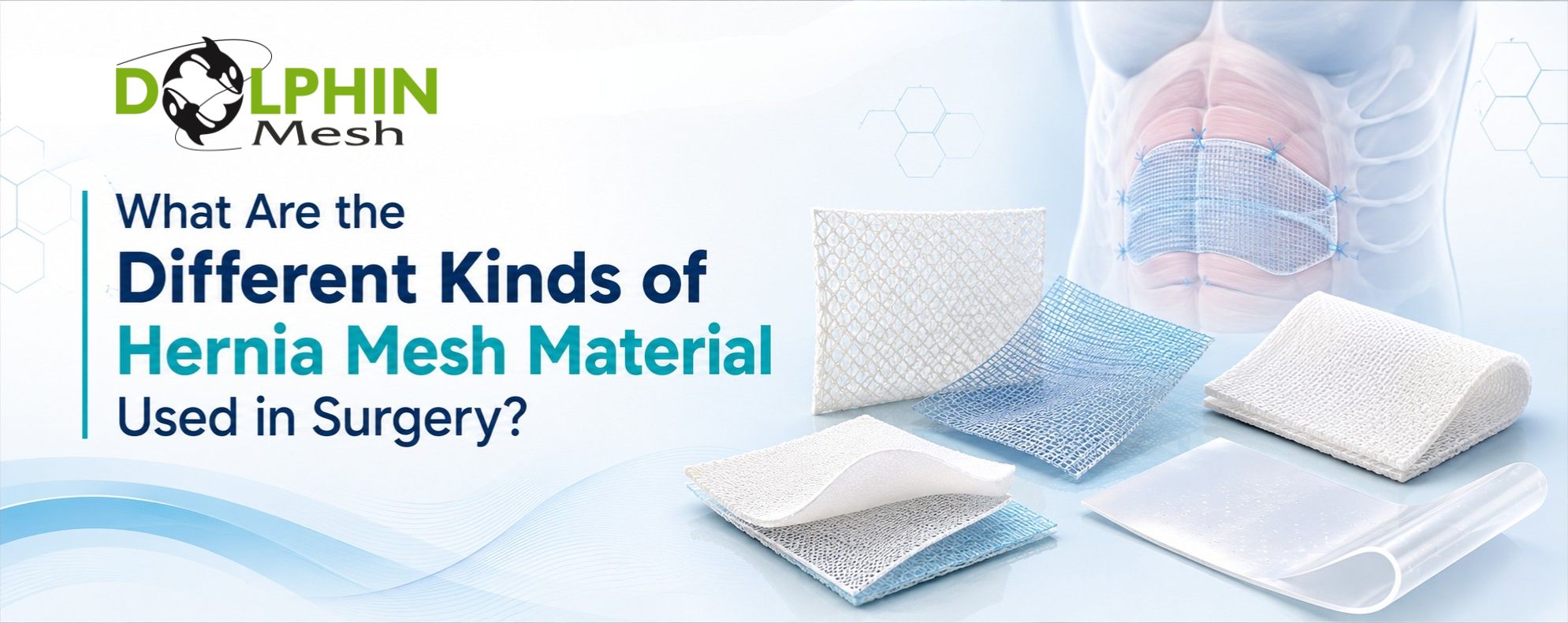
Hernia repair is one of the most common surgical procedures, and the choice of mesh material plays an important role in long-term repair strength, tissue support, patient comfort and surgical handling. A hernia mesh is used to reinforce the weakened area of the abdominal wall and support tissue ingrowth after repair. Dolphin Mesh offers a wide portfolio of surgical hernia mesh solutions, including polypropylene, laminar and composite meshes for different hernia repair techniques.
Why Mesh Material Matters in Hernia Surgery
Every hernia case is different. The surgeon may need a lightweight mesh, a strong permanent mesh, a composite mesh with an anti-adhesion barrier or a partially absorbable mesh depending on the surgical site and patient requirement. The right material helps provide support while balancing flexibility, tissue integration and comfort.
Dolphin Mesh is a hernia mesh portfolio from Futura Medtech with 26+ years of medical industry experience, offering products for tension-free and laparoscopic tension-free hernia repairs.
1. Polypropylene Mesh
Polypropylene is one of the most widely used materials in hernia repair. It is a non-absorbable synthetic material known for strength, durability and tissue ingrowth support. In hernia surgery, polypropylene mesh is commonly used to reinforce weakened tissue and reduce recurrence risk by giving additional support to the abdominal wall.
Dolphin Mesh offers Polypropylene Mesh as part of its surgical mesh range. Polypropylene-based meshes are commonly selected where long-term reinforcement is required.
2. Polyester Mesh
Polyester mesh is another important material used in hernia repair. It is valued for its handling, strength and knitted structure. In Dolphin Mesh’s portfolio, Ultralene Mesh is a polyester-polyethylene composite mesh. It has one layer of polyester mesh and another layer of medical-grade polyethylene film. The polyester side supports tissue ingrowth, while the polyethylene layer works as a barrier against adhesions on the visceral side.
Ultralene Mesh is designed for soft tissue reconstruction and has a low-profile design, which can help in laparoscopic deployment. Its large pore structure supports connective tissue growth, while its composite design aims to balance strength, softness and reliability.
3. PTFE Composite Mesh
PTFE, or polytetrafluoroethylene, is often used in composite mesh designs where an anti-adhesion barrier is required. Teflene Mesh is a polypropylene-PTFE composite mesh with polypropylene knitted mesh on the parietal side and expanded PTFE sheet on the visceral side. The PTFE layer acts as a permanent barrier to adhesions, while the polypropylene layer supports tissue growth.
This type of mesh is useful in procedures where the mesh may be placed near internal organs and where reducing adhesion risk is important. Teflene Mesh also includes perforated holes to help prevent fluid accumulation and seroma formation.
4. Polypropylene-Polyethylene Composite Mesh
Composite meshes combine two functional layers to achieve specific surgical benefits. Duolene Mesh is made from lightweight polypropylene mesh on the parietal side and medical-grade polyethylene film on the visceral side. These layers are fused without adhesive, which helps improve the biocompatibility quotient of the mesh.
The polypropylene surface encourages tissue ingrowth, while the polyethylene film minimizes tissue ingrowth and foreign body reaction on the visceral side. Duolene Mesh is also transparent, which helps surgeons visualize the underlying anatomy during placement.
5. Titanised Polypropylene Mesh
Titanised polypropylene mesh is designed to improve biocompatibility and reduce inflammatory response. Tiolene Mesh is a lightweight, monofilament titanised polypropylene mesh. Its fibers are covered with a titanium dioxide surface coating to enhance biocompatibility.
Tiolene Mesh has a large pore structure, good tensile and bursting strength, and excellent handling properties. Dolphin Mesh highlights benefits such as better tissue ingrowth, less shrinkage, less adhesion, reduced post-operative pain and lower foreign body sensation.
6. Partially Absorbable Composite Mesh
Partially absorbable mesh is designed to reduce the amount of permanent foreign material left in the body after healing support is achieved. Monosolve Mesh is a partially absorbable knitted composite mesh made from absorbable PGCL polymer and non-absorbable polypropylene monofilament fiber. Its absorbable component is absorbed in 90–121 days, leaving the polypropylene mesh to provide continued support.
This mesh is lightweight, flexible and macroporous. Dolphin Mesh notes that it leaves behind 65% less foreign material compared with some traditional meshes after partial absorption, which may support patient comfort.
How Surgeons Choose the Right Hernia Mesh Material
The selection of hernia mesh depends on factors such as hernia type, repair technique, anatomical location, need for anti-adhesion protection, tissue quality and patient-specific risk factors. For example, polypropylene mesh may be preferred for strong long-term reinforcement, composite mesh may be selected when an anti-adhesion barrier is needed, and partially absorbable mesh may be chosen where reduced foreign material is desired.
Conclusion
Different hernia mesh materials serve different surgical purposes. Polypropylene, polyester, PTFE, polyethylene composite, titanised polypropylene and partially absorbable PGCL-polypropylene meshes all have unique advantages. Dolphin Mesh provides a broad surgical hernia mesh portfolio designed to support surgeons with strength, flexibility, biocompatibility and comfort across different hernia repair needs.
For surgeons, hospitals and distributors looking for reliable hernia mesh solutions, Dolphin Mesh offers a wide range of options for modern hernia repair.