






Lightweight, Heavyweight, Macropore: Choosing a Polypropylene Hernia Mesh
Monofilament polypropylene has been the workhorse of hernia repair for decades. It is strong, non-absorbable and well characterised. But "polypropylene mesh" covers a wide range of products, and two properties in particular shape how a mesh behaves: its weight and its pore size.
Weight: how much material is implanted
Mesh weight is expressed as areal density — grams of material per square metre. The terms used are relative rather than strict categories, but broadly:
- Heavyweight meshes use thicker filaments and a denser knit. They are very strong and stiff.
- Lightweight meshes use less material, usually with thinner filaments and a more open knit. They are more flexible and conform more easily to the abdominal wall.
The abdominal wall does not need the tensile strength of a heavyweight mesh in most repairs. Lighter meshes have been associated in studies with less foreign body sensation and stiffness, while heavier meshes may be preferred where maximum strength is required, such as large defects or reconstructions.
Pore size: how tissue integrates
Pore size is the dimension of the openings in the knit. Large pores (often described as macroporous) let fibrous tissue and blood vessels grow through the mesh, so it becomes integrated rather than encapsulated. Very small pores can be "bridged" by scar tissue, producing a stiffer scar plate. Large pores also help drainage and visibility through the mesh during placement.
Weight and pore size are related but not the same: a mesh can be light because of thinner filaments while keeping a similar pore structure, or more open because of a different knit. That is why it is worth reading a mesh's specification rather than relying on a single adjective — see our reference article on mesh pore size and weight.
The four Knit variants
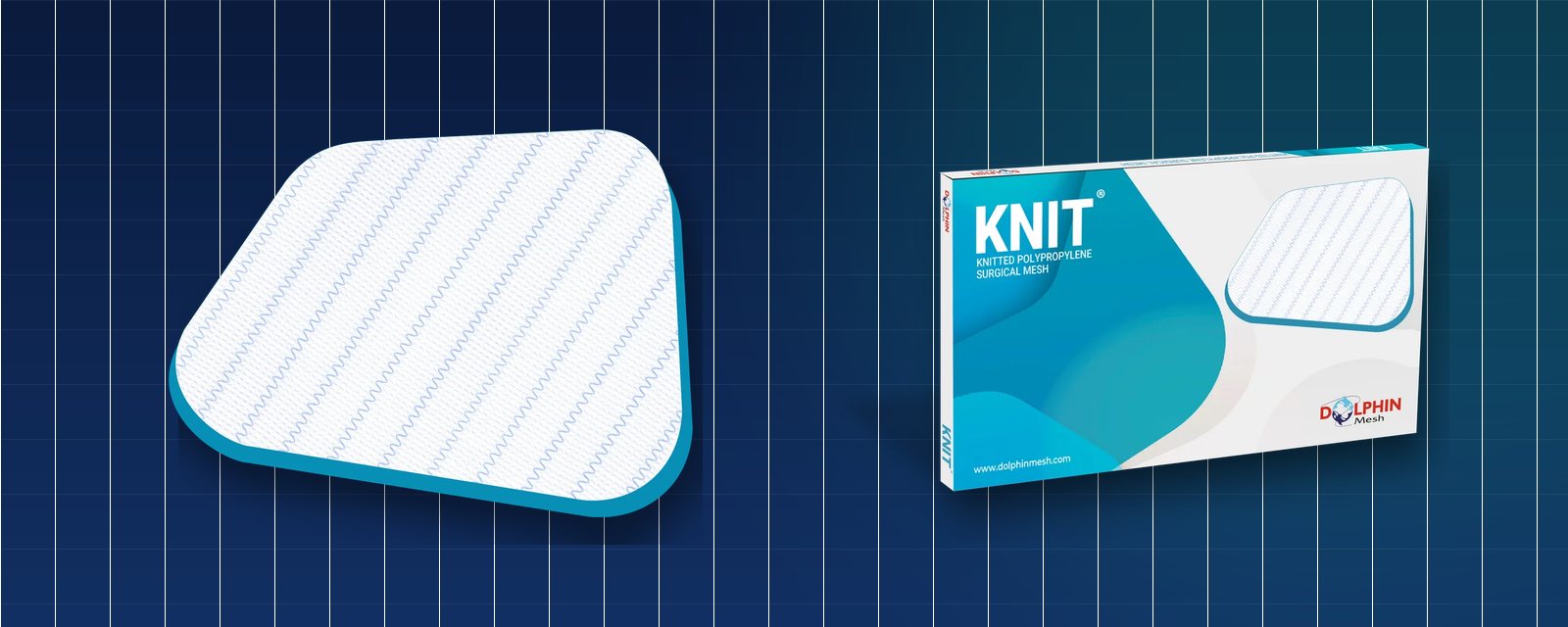
Knit is Dolphin's knitted monofilament polypropylene mesh, made in four variants so that the mesh can be matched to the repair, the defect and the surgeon's preference:
- Ultra Soft — the softest, most flexible handling; rectangular sizes from 6 × 11 cm to 15 × 15 cm and circles from 8 to 15 cm.
- Soft — a versatile, flexible mesh in the widest choice of sizes, from 6 × 11 cm up to 30 × 30 cm, plus circles.
- Macropore — a large-pore construction for tissue integration and visibility, from 6 × 11 cm to 15 × 15 cm and circles.
- Robust — a stronger construction for demanding repairs, up to 30 × 30 cm and a 50 × 50 cm sheet (AWR5050) for large abdominal wall reconstructions.
All 41 Knit codes are listed on the Knit product page, where you can filter by variant, shape and size.
Finishing matters too
How a mesh is finished affects handling. Knit is cut to precision with all edges sealed to avoid loose fibres, thermally annealed to prevent curling and increase softness, and ultrasonically cleaned before packing. Futura Surgicare describes Knit as smooth, soft, strong and flexible, designed to minimise patient discomfort, with ideal porosity for visibility and colonisation.
Choosing
There is no single best weight or pore size; the right mesh depends on the hernia, its size, the plane of placement and the surgeon's experience. Lighter, large-pore meshes suit many routine repairs, while stronger meshes are chosen where load is greater. Final selection rests with the operating surgeon.
This article is general information for healthcare professionals. Product statements are from Futura Surgicare product literature; always refer to the Instructions for Use.
Distributor, hospital or surgeon?
Request product information, samples or regulatory documentation. Supplying hospitals and distributors in 85+ countries from Bangalore.