







Inguinal Hernia Repair: Lichtenstein, TAPP and TEP — and Where a 3D Mesh Fits
Inguinal hernia repair is one of the most frequently performed operations in general surgery. Almost all adult repairs today use mesh, and the main decision is the route: open or laparoscopic. This article summarises the main techniques and where pre-shaped three-dimensional meshes fit in.
Open repair: Lichtenstein
The Lichtenstein tension-free repair is the most widely used open technique. Through a groin incision, the surgeon places a flat mesh on the posterior wall of the inguinal canal, shaping it around the spermatic cord, and fixes it to the surrounding tissues. It can be performed under local, regional or general anaesthesia and is well suited to day-case surgery. A flat knitted polypropylene mesh such as Knit — supplied in rectangular sizes from 6 × 11 cm upward — is a common choice.
Laparoscopic repair: TAPP and TEP
Laparoscopic repairs place the mesh behind the abdominal wall muscles, in the preperitoneal space, where it covers the whole myopectineal orifice — the area through which inguinal and femoral hernias occur.
- TAPP (transabdominal preperitoneal) — the surgeon enters the abdominal cavity, opens a flap of peritoneum, places the mesh in the preperitoneal space and closes the peritoneum over it so the mesh does not contact the bowel.
- TEP (totally extraperitoneal) — the surgeon works entirely within the preperitoneal space without entering the abdominal cavity. It is technically more demanding but avoids the peritoneal cavity altogether.
Compared with open repair, laparoscopic repair is associated with less post-operative and chronic pain and a quicker return to normal activities for many patients. It is particularly attractive for bilateral hernias, which can be repaired through the same ports, and for recurrences after an open repair. It requires general anaesthesia and surgical expertise.
Why mesh size and shape matter in the groin
In a laparoscopic repair, the mesh must cover the myopectineal orifice with adequate overlap; guidelines advise a mesh of at least 10 × 15 cm for most adults. Flat meshes are cut and positioned to fit the curved anatomy of the groin, and many surgeons fix them with tacks, sutures or glue to prevent movement while tissue integrates.
Pre-shaped 3D anatomical meshes
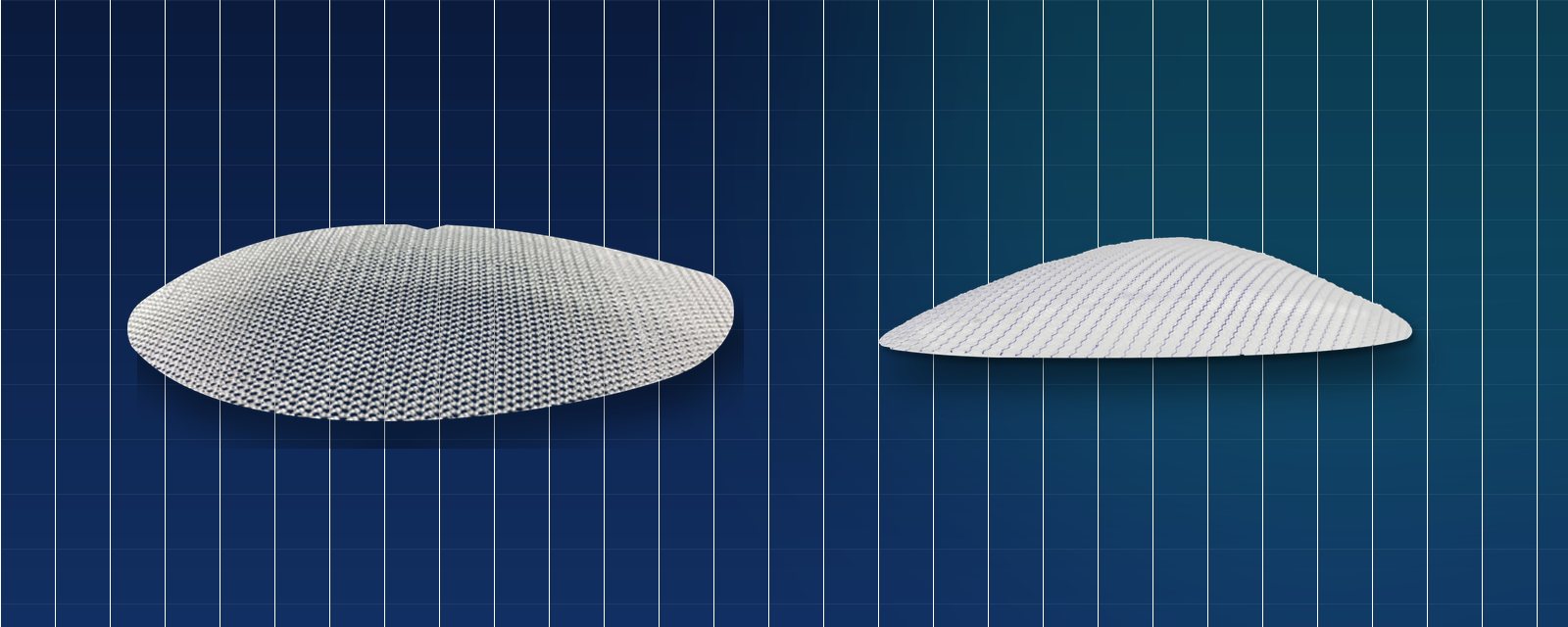
A three-dimensional anatomical mesh is pre-shaped to follow the contours of the inguinal region rather than lying flat. It is supplied in left and right versions and is designed to support placement and handling during laparoscopic repair.
- Knit 3D — a pre-shaped, non-absorbable monofilament polypropylene mesh in Macropore and Medium pore versions, in Medium (10 × 13 cm), Large (11 × 15 cm) and Extra Large (12 × 17 cm) sizes, left and right — 12 codes in all.
- Monosolve V2 3D — the same anatomical concept in a partially absorbable construction of polypropylene and poliglecaprone 25. The absorbable component is resorbed after implantation, reducing the foreign material left in the body.
Whether and how a 3D mesh is fixed is decided by the surgeon according to the hernia type, its size and the technique used, and in line with the Instructions for Use.
Choosing the approach
The best repair depends on the patient (fitness for general anaesthesia, previous surgery, bilateral or recurrent hernia), the hernia, and the expertise available. Both open and laparoscopic mesh repairs are well established. Dolphin Mesh supplies meshes for both routes — flat knitted sheets for Lichtenstein and laparoscopic repair, and pre-shaped 3D meshes for TAPP and TEP — together with Tacksure for mesh fixation.
This article is general information for healthcare professionals and is not a substitute for surgical training or the Instructions for Use.
Distributor, hospital or surgeon?
Request product information, samples or regulatory documentation. Supplying hospitals and distributors in 85+ countries from Bangalore.