







Ventral and Incisional Hernia: Why IPOM Repair Needs a Composite Barrier Mesh
Ventral hernias — umbilical, epigastric and especially incisional hernias after previous surgery — are among the most challenging hernias to repair durably. One widely used minimally invasive option is the laparoscopic intraperitoneal onlay mesh (IPOM) repair, and it places unusual demands on the mesh.
How IPOM works
In an IPOM repair, the surgeon enters the abdominal cavity laparoscopically, frees the hernia contents and any adhesions, and fixes a mesh to the inner surface of the abdominal wall so that it covers the defect with a generous overlap — commonly around 5 cm beyond the defect edges in every direction. In the "IPOM-plus" variant, the defect itself is first closed with sutures before the mesh is placed. Fixation typically uses tacks, transfascial sutures, or both.
Because the mesh lies inside the peritoneal cavity, one face is pressed against the abdominal wall while the other faces the bowel and other organs. That is the defining challenge of IPOM.
Two sides, two jobs
A plain knitted mesh is designed to be incorporated into tissue — which is exactly what you want against the abdominal wall, and exactly what you do not want against the bowel, where tissue ingrowth can lead to adhesions. The solution is a dual-sided composite mesh:
- a parietal side — an open, porous textile that encourages tissue integration with the abdominal wall;
- a visceral side — a smooth barrier film or sheet intended to minimise tissue attachment to the bowel.
A composite has an orientation: the barrier must face the viscera. Composite meshes therefore carry orientation features, and the Instructions for Use specify which side faces where.
The Dolphin composite range
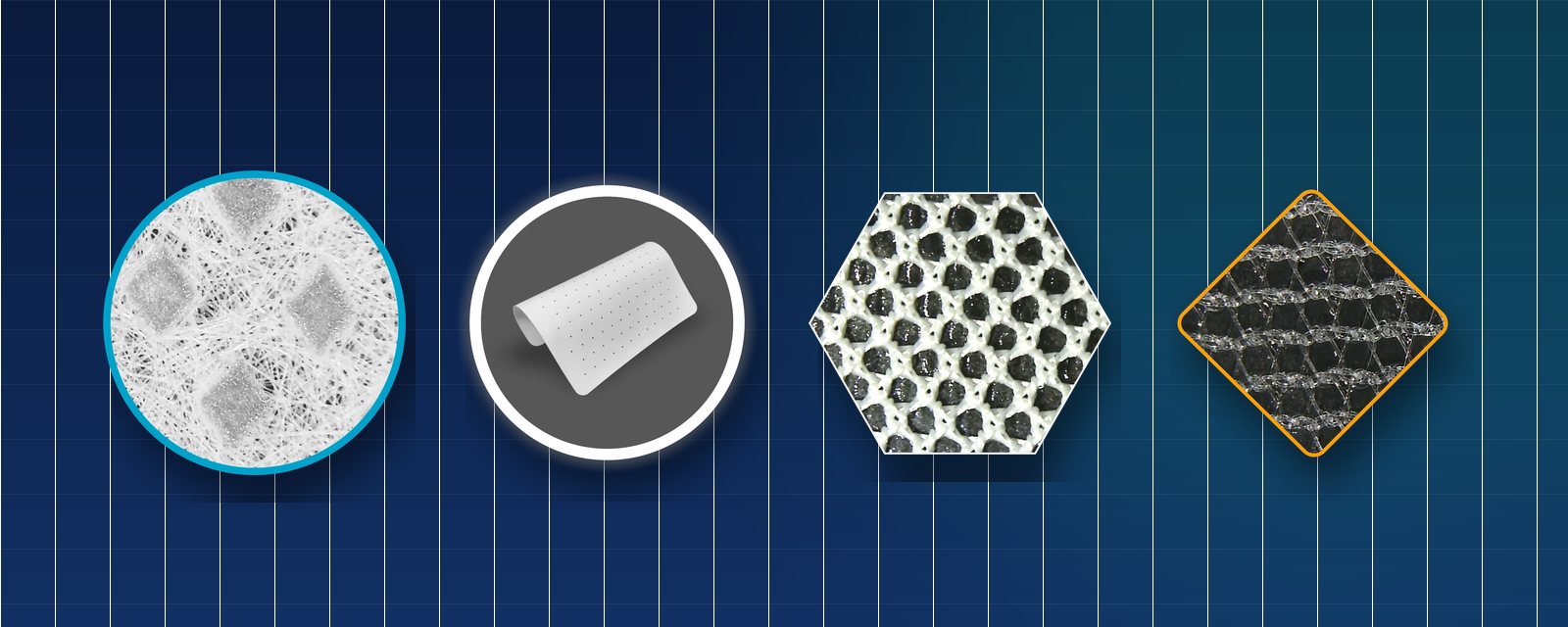
Dolphin Mesh offers India's largest composite mesh portfolio. Four of its composites are designed for intraperitoneal repair, each pairing a different textile with a different barrier:
- Silene — a 3D polymer matrix on the parietal side and a medical-grade silicone film on the visceral side. Futura Surgicare was the first Indian company to launch a silicone-based composite mesh. Its literature describes a bursting strength providing 5–10× the support the abdominal wall needs during extreme physical activity, and complete vascularised incorporation at 12 days.
- Teflene — macroporous knitted polypropylene fused to an expanded PTFE (ePTFE) barrier. PTFE is an inert fluoropolymer, and the company describes Teflene as a permanent-barrier composite with excellent anti-adhesion properties, less foreign body reaction and comparatively lower scar density.
- Ultralene — macroporous knitted polyester with a low-density polyethylene film on the visceral side. The first PET & PE composite mesh launched by an Indian company, and the strongest mesh in the Dolphin portfolio, with the highest burst strength.
- Duolene — lightweight knitted polypropylene with a medical-grade polyethylene film, the layers thermally fused without adhesive. Transparent for visualisation of the underlying anatomy; the first PP & PE composite mesh launched by an Indian company.
All four are non-absorbable, supplied sterile for single use, low profile for laparoscopic placement, and include micropores or perforations for seroma drainage. They come in rectangular, square and circular sizes for open and laparoscopic repair — see each product's ordering table or the code finder.
Key features of Dolphin composite meshes
- Low weight — less foreign body reaction.
- Low profile — easy passage through the trocar.
- Permanent barrier — permanent protection against adhesion, shrinkage and migration.
- Easily customisable — can be trimmed by the surgeon without frayed or sharp edges.
- No preparation — ready to use, with no need to immerse in any solution.
Beyond IPOM
Ventral hernia surgery continues to evolve, with retromuscular (sublay) repairs, enhanced-view TEP (eTEP) and robotic approaches that place the mesh outside the peritoneal cavity. In those planes a barrier is not required and a knitted mesh such as Knit — including the 50 × 50 cm Robust sheet for large abdominal wall reconstructions — may be used instead. The plane of placement, not the hernia alone, determines whether a composite is needed.
This article is general information for healthcare professionals. Performance and ‘first’ statements are from Futura Surgicare product literature; always refer to the Instructions for Use.
Distributor, hospital or surgeon?
Request product information, samples or regulatory documentation. Supplying hospitals and distributors in 85+ countries from Bangalore.