







Fixing the Mesh: Tackers, Sutures and Glue in Laparoscopic Hernia Repair
After a mesh is positioned, it must stay where the surgeon placed it while the patient's tissue grows into it. Movement or folding during that period can lead to recurrence. Fixation is how the mesh is held in place — and it is a separate decision from the choice of mesh.
The fixation options
- Tacks — small fasteners, often helical (spiral), delivered through a laparoscopic port by a tacker. They come in permanent (typically titanium) and absorbable polymer forms.
- Sutures — stitches placed by hand, including transfascial sutures passed through the full thickness of the abdominal wall in ventral repairs.
- Adhesives — fibrin sealant or synthetic glue that holds the mesh without penetrating tissue.
- No fixation — in some repairs, particularly with appropriately sized or pre-shaped meshes in certain laparoscopic groin repairs, surgeons may decide fixation is unnecessary.
Where tacks are used
Tacks are widely used in laparoscopic ventral (IPOM) repair, where the mesh must be held against the inner abdominal wall, often in combination with transfascial sutures. In the groin, surgeons take particular care with penetrating fixation near nerves and vessels, and many prefer atraumatic options or no fixation in suitable cases. The surgeon chooses the method, the number and the position of fasteners for each repair.
Absorbable or permanent fasteners?
A permanent titanium tack remains in the body; an absorbable tack is resorbed after it has served its purpose, so the fixation element does not remain indefinitely. The choice depends on the surgeon's preference, the repair and what is intended to remain in the long term — always checked against the Instructions for Use of both the mesh and the tacker.
Tacksure
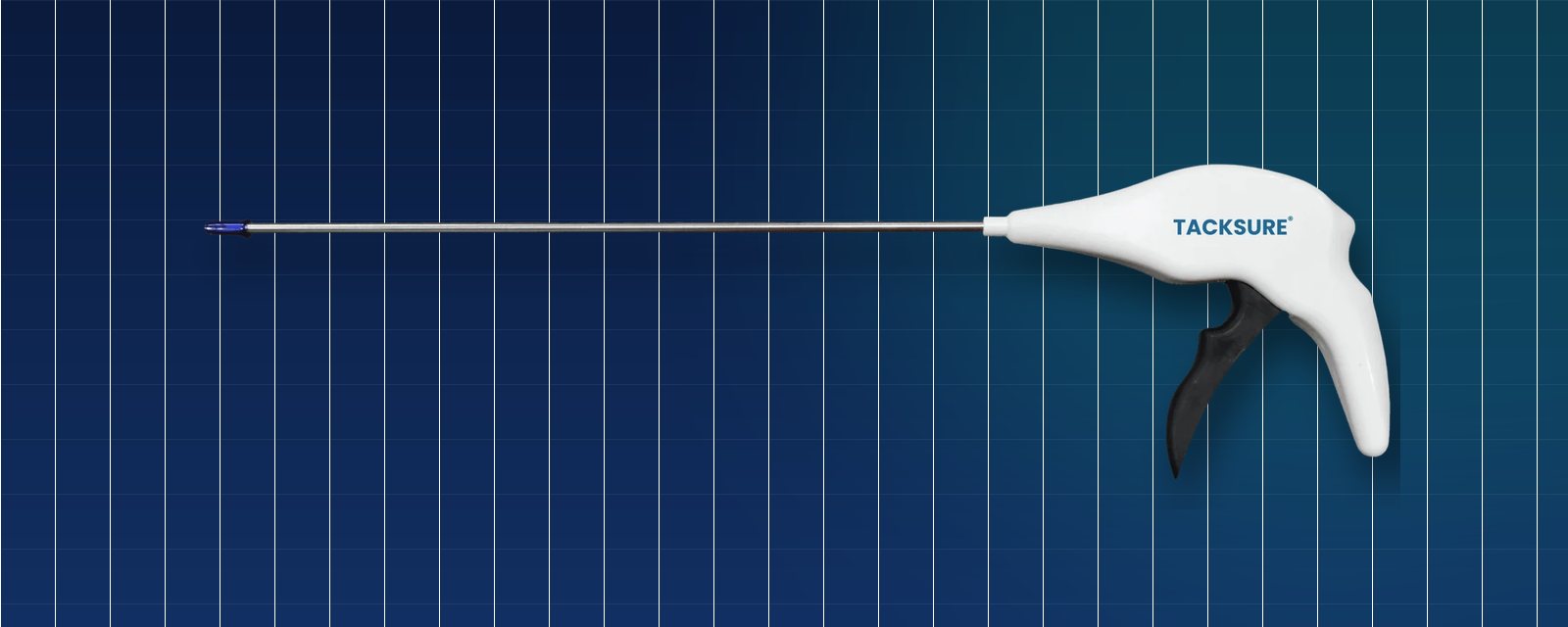
Tacksure is a sterile, single-use 5 mm mesh tacker for laparoscopic and open hernia repair, with a 350 mm shaft. It delivers one fastener per activation, so each fastener is placed deliberately, and it is compatible with a range of meshes including single-layer and composite types. It is available in three presentations:
- DST20 — 20 titanised helical fixators;
- DST30 — 30 titanised helical fixators;
- DST30A — 30 absorbable PGLA fixators.
Choose the count to match the mesh size and the number of fixation points planned, and the fastener material to match what the surgeon intends to remain.
Fixation and mesh are separate choices
A mesh is selected on its construction; fixation on how it is to be held, by what, and whether that element should remain. Treating them as one decision obscures both. Our reference article on mesh fixation covers the options in more depth.
This article is general information for healthcare professionals and is not a substitute for surgical training or the Instructions for Use.
Distributor, hospital or surgeon?
Request product information, samples or regulatory documentation. Supplying hospitals and distributors in 85+ countries from Bangalore.