







Partially Absorbable Hernia Mesh: How Monosolve V2 Works
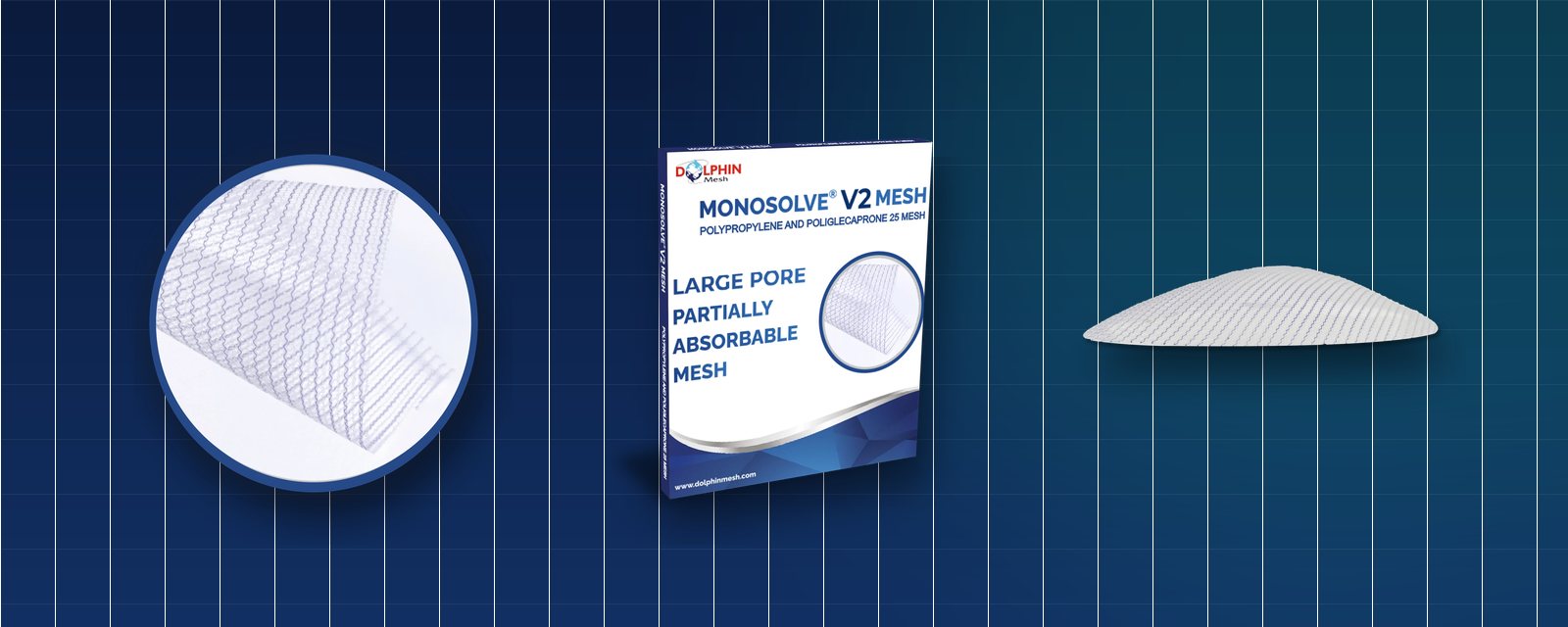
Every permanent mesh leaves foreign material in the abdominal wall for life. Partially absorbable — also called semi absorbable — meshes were developed to reduce that long-term load while keeping the handling and initial strength surgeons need at the time of surgery.
How a partially absorbable mesh is built
A partially absorbable mesh combines two materials in one knitted construction:
- a non-absorbable component — usually monofilament polypropylene — that stays in place permanently and provides lasting reinforcement;
- an absorbable component that adds body and stiffness at implantation and is then gradually resorbed by the body.
Once absorption is complete, a lightweight polypropylene structure remains, integrated into the patient's tissue.
Monosolve V2
Monosolve V2 combines non-absorbable polypropylene with absorbable poliglecaprone 25 — the polymer used in absorbable monofilament sutures. The absorbable component is resorbed in 90–120 days, leaving the polypropylene in place to continue supporting the repair.
According to Futura Surgicare's product literature:
- poliglecaprone 25 is absorbed after implantation, reducing the foreign material left in the body;
- the non-absorbable polypropylene continues to provide the required support to the defect area;
- good tissue ingrowth with low foreign body mass after partial absorption allows a potentially more comfortable repair;
- the mesh has high suture pull-out and tensile strength and withstands extreme intra-abdominal pressure;
- a macroporous design promotes fluid flow-through, potentially reducing the risk of seromas.
Monosolve V2 is supplied as flat sheets for open and laparoscopic inguinal, ventral and incisional repair. It is not a barrier mesh, so it is intended for placement where it does not face the bowel.
Monosolve V2 3D
Monosolve V2 3D brings the same material combination to a pre-shaped, three-dimensional anatomical mesh for laparoscopic inguinal repair, in left and right configurations across three sizes. It combines the contoured shape of a 3D mesh with the reduced long-term footprint of a partially absorbable construction.
When is a partially absorbable mesh chosen?
Surgeons may prefer a partially absorbable mesh where they want the handling of a stiffer mesh during placement and a lighter permanent implant afterwards — for example in many inguinal repairs. As always, the choice depends on the defect, the approach and the plane of placement, and rests with the operating surgeon.
This article is general information for healthcare professionals. Product statements are from Futura Surgicare product literature; always refer to the Instructions for Use for indications and absorption data.
Distributor, hospital or surgeon?
Request product information, samples or regulatory documentation. Supplying hospitals and distributors in 85+ countries from Bangalore.